TempoPFN: Synthetic Pre-training of Linear RNNs for Zero-shot Time Series Forecasting
https://arxiv.org/pdf/2510.25502
Abstract
1. Motivation
Zero-shot TSFM
- Long-horizon prediction에서 비효율적
- Reproducibility가 낮음
- Synthetic-only pretraining 접근은 어려운 benchmark에서 성능이 낮음
2. Proposal: TempoPFN
- Overview
- (1) Univariate TSFM
- (2) Linear RNN 기반
- (3) Synthetic data만 사용해 pre-training
- Architecture
- (1) GatedDeltaProduct
- (2) State-weaving
- Sequence length 전반에 대해 fully parallelizable training
- (3) Windowing이나 summarization 없이 TS state를 직접 추적
- Synthetic data
- 다양한 generator를 통합
- Stochastic Differential Equations (SDEs)
- Gaussian Processes (GPs)
- Audio synthesis
- Novel augmentation 포함
- 다양한 generator를 통합
3. Performance & Efficiency & Reproducibility
-
**Performance**
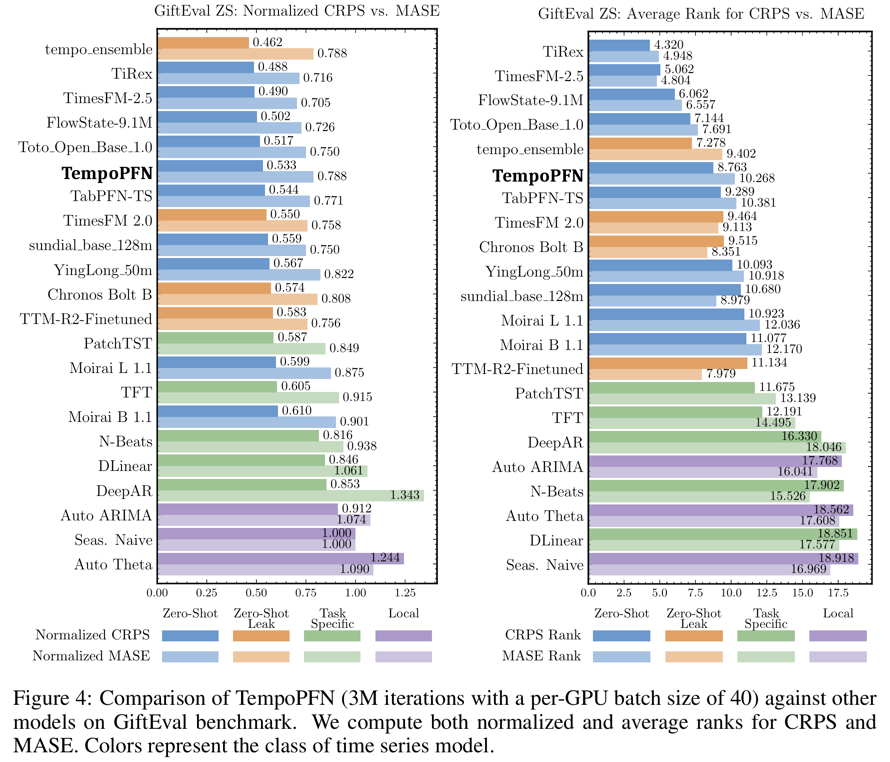
- Gift-Eval, fev-bench, Chronos-ZS benchmark에서 평가
- 모든 기존 synthetic-only 방법을 상회
- 다수의 real-world data로 학습한 모델보다도 높은 성능
-
Efficiency
-
Training과 inference 모두 fully parallelizable
-
기존 foundation baseline 대비 계산 효율 우수
-
-
Reproducibility
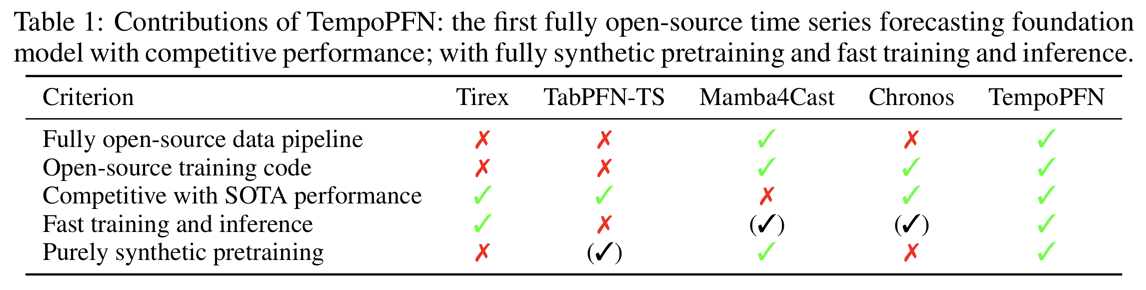
- Synthetic data generation pipeline 공개
- Training code 공개
- Reproducible TS foundation model 연구 기반 제공
1. Introduction
a) Background
TSFM: Fine-tuning 없이 zero-shot prediction 가능
TSFM 한계점?
- (1) Transformer
- Quadratic complexity
- Long-horizon에서 error accumulation
- (2) Non-linear RNN (e.g., TiReX)
- Temporal state 유지 가능
- Sequential processing으로 scalability 제한
- (3) Synthetic-only pre-training 모델들
- Gift-Eval에서 SoTA 미달
- TabPFN-TS는 성능은 우수하나 synthetic data 비공개 → Reproducibility 부족
b) Proposal: TempoPFN
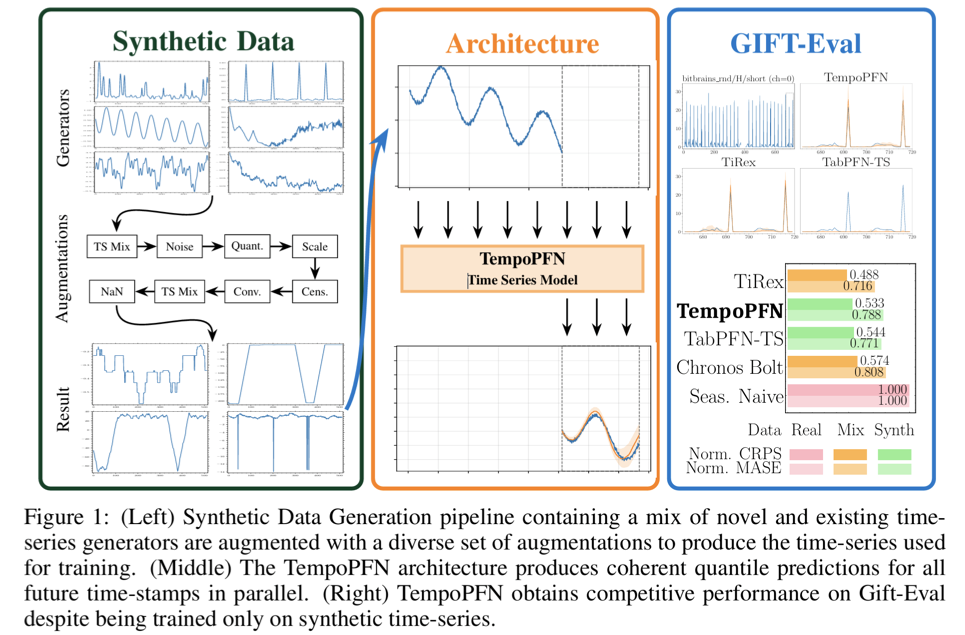
- PFN framework
- Arch:
- Linear RNN
- GatedDeltaProduct recurrence
- Fully parallelizable training & inference
c) Findings
- [1] Architecture TS forecasting에 Non-linear RNN이 필수는 아님
- Linear RNN + GatedDeltaProduct만으로도 충분한 state-tracking 가능
- DeltaProduct는 orthogonal rotation 기반 → Diagonal SSM보다 우수한 state 유지
- Linear RNN + GatedDeltaProduct만으로도 충분한 state-tracking 가능
- [2] Synthetic pre-training 전략
- Diverse synthetic generators + novel augmentations
- Real-world data 미사용 → benchmark leakage 방지
- 전체 pipeline과 code open-source 공개
d) Contributions
- (1) Architecture
- Linear RNN 기반 univariate TSFM 최초
- Windowing·patching 없이 모든 future horizon 병렬 예측
- State-weaving으로 horizon 간 정보 흐름 강화
- (2) Data pipeline
- Fully synthetic, leakage-free, reproducible
- (3) Performance
- Gift-Eval, fev-bench, Chronos-ZS에서 top-tier zero-shot 성능
- 대부분의 real-world data 기반 모델 상회
2. Background & Related Works
(1) Time Series Forecasting
- Classical methods
- ARIMA, Exponential Smoothing → point estimate 중심
- Probabilistic forecasting
- Predictive distribution \(p(y_{T+1:T+H} \mid y_{1:T})\) 모델링
- Deep learning 기반
- Transformers, modern RNNs
(2) Zero-shot forecasting
- Fine-tuning 없이 unseen TS 예측
- 주류 접근은 transformer 기반
- Chronos, TimesFM, MOIRAI
- MOIRAI(-MOE)가 Gift-Eval SOTA
(3) PFNs & Synthetic Data
- PFN은 task solver가 아닌 inference algorithm 자체를 학습
- Synthetic prior에서 dataset을 샘플링하여
- Posterior predictive distribution 근사
- In-context learning = fast approximate Bayesian inference
- 성능은 prior의 표현력에 의해 결정
-
기존 사례: TabPFN, ForecastPFN, TimePFN, TabPFN-TS
- Proposal) TempoPFN
- 자체 synthetic temporal-dynamics pipeline을 prior로 사용
- Unseen TS에 대한 zero-shot probabilistic forecasting 가능
(4) Linear RNNs and State-Space Models
- 최근 long-horizon TS forecasting에서 RNN 재조명
- TiRex
- Non-linear RNN (xLSTM) + 일부 real data 사용
- Proposal) TempoPFN
- Linear RNN + GatedDeltaProduct
- Fully parallelizable training & inference
- Synthetic-only pretraining → leakage 없음
- Linear RNN 장점
- Chunk-wise parallelization / associative scan 가능
- 기본 형태
- State update: \(H_i = A(x_i)H_{i-1} + B(x_i)\).
- Output: \(\hat{y}_i = \text{dec}(H_i, x_i)\)
- Diagonal transition 계열
- Mamba, GLA, mLSTM
- More expressive linear RNNs
- DeltaNet, TTT-Linear, RWKV-7, Titans
3. TempoPFN
(1) Architecture
Overall Goal
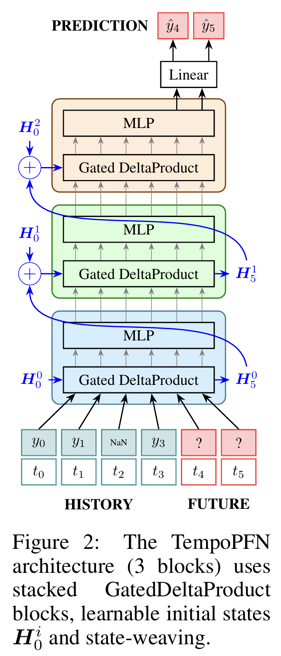
- Univariate TS를 전체 prediction horizon에 대해 single forward pass로 예측하도록 설계됨
- Windowing이나 요약 없이 모든 time step을 직접 처리
a) Input Representation
- History (time steps + values) & Future (time steps) \(\rightarrow\) 하나의 token sequence로 concat
- (1) Historical steps
- 값 \(y_i\)는 linear projection
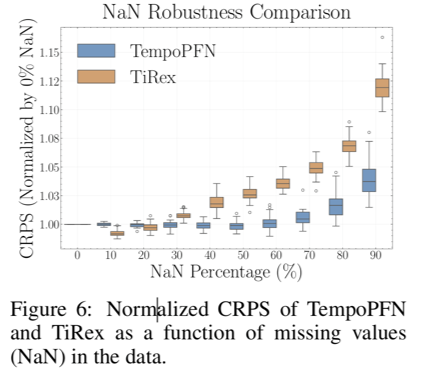
- Missing value는 learnable NaN embedding
- Value embedding과 time-feature embedding을 additive하게 결합
- (2) Future steps
- Time-feature embedding만 사용
- (1) Historical steps
- Future time steps 간 정보 교환을 허용해 coherent prediction 유도
- 각 time step은 GluonTS time features (seasonality, day-of-week, index 등)를 사용
- TiReX와 달리 window-based presummarization을 사용하지 않음
b) Backbone
- 10개의 encoder layer로 구성
- 각 layer는 Gated DeltaProduct block 기반
-
주요 구성 요소
- Gated DeltaProduct recurrence + short 1D convolution (kernel 16–32)
- (Recurrent unit 이전의) Pre-normalization
- Channel-wise 변환을 위한 gated MLP
-
두 가지 장점
- (1) Linear recurrence의 parallelization
- (2) Convolution, MLP의 표현력을 결합
-
DeltaProduct는 Householder transformation의 곱으로 hidden state transition을 표현
-
Head 수 증가 시
- Length extrapolation
- State tracking
- Sequence modeling 능력이 향상됨
c) Non-causality via State Weaving
- Full-horizon forecasting은 causal masking이 필요하지 않다는 점을 활용
- 각 layer의 final hidden state H_t^i를 다음 layer의 learnable initial state H_0^{i+1}에 더함
- 추가 parameter나 explicit bidirectional 구조 없이 bidirectional information flow를 구현
- History와 future 전체에 접근 가능
- Causal RNN에서 발생하는 prediction 단계의 information bottleneck을 방지
(2) Synthetic Data Generation
Overall Strategy
-
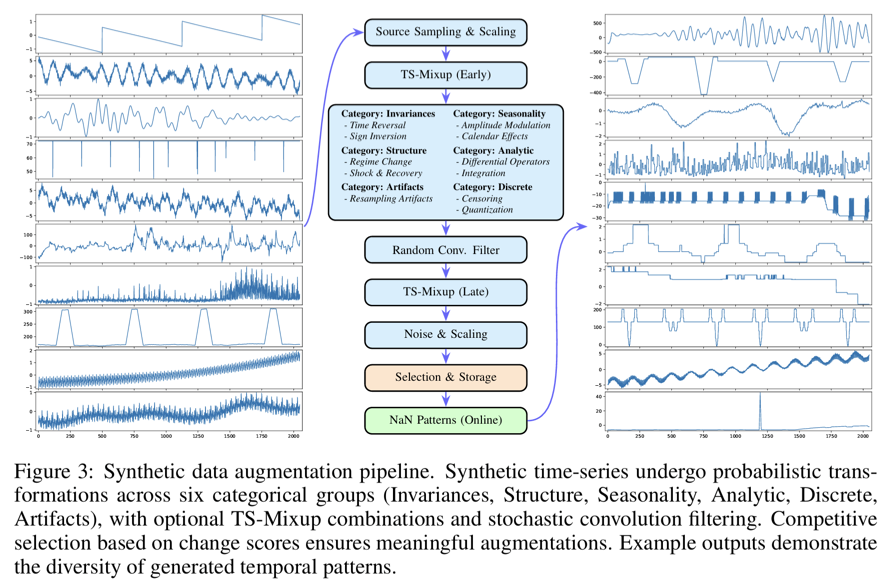
TSFM pretraining을 위해 10개의 synthetic generator 사용
-
기존 방법 + novel generator를 결합
\(\rightarrow\) 보다 넓은 temporal pattern space를 커버
a) Existing Generators
-
ForecastPFN Generator
- Trend와 seasonality의 multiplicative composition
- Linear, exponential growth + sinusoidal harmonics
- Weibull noise, time warping, magnitude scaling, spike injection 포함
- Extreme value를 방지하는 filtering 적용
-
KernelSynth
- Gaussian Process prior에서 univariate TS 샘플링
- Periodic, stationary, noise kernel을 additive 또는 multiplicative하게 결합
- Smooth하면서도 다양한 trajectory 생성
-
Extended Gaussian Process Generator
- KernelSynth를 확장해 더 다양한 kernel 조합 사용
- Stationary와 non-stationary pattern의 범위를 확장
-
CauKer
- Structural Causal Model 기반 generator
- Random DAG에서 causal dependency를 도입
- Multivariate TS를 생성한 뒤 각 channel을 독립적인 univariate TS로 사용
- 상호 의존적인 dynamics를 간접적으로 반영
b) Novel Generators
- Sawtooth
- Upward 또는 downward ramp 형태의 pattern
- 약한 trend와 low-amplitude seasonality로 과도한 이상화 방지
- Step Function
- Changepoint 기반 piecewise constant TS
- Gaussian smoothing, noise, seasonality, anomaly 포함
- Anomaly
- Baseline signal 위에 spike를 주기적 또는 cluster 형태로 삽입
- Spike magnitude는 constant, trending, cyclical, random regime을 따름
- Spikes
- Flat baseline 위에 sharp event-driven spike 배치
- V, inverted V, plateau 형태
- Bursty 또는 evenly spaced 패턴
- Sine Wave
- Period, amplitude, phase, noise를 제어 가능한 기본 oscillatory signal
- Periodicity 학습을 위한 기초 패턴 제공
c) Audio-Inspired Generators
-
Procedural audio synthesis 기법을 TS에 적용
-
Event-driven, highly complex dynamics를 모델링
-
예시
- Stochastic Rhythms (event data)
- Financial Volatility (shock, clustering)
- Network Topology (traffic burst, congestion)
- Multi-Scale Fractals (self-similarity)
d) SDE Generator (Core Contribution)
-
Regime-switching, time-inhomogeneous Ornstein–Uhlenbeck process 기반
-
Mean, volatility, mean-reversion speed가
- Time t와 latent regime r_t에 의존
-
Regime는 Markov chain으로 전이
-
Parameter는 polynomial, sinusoidal, logistic, piecewise-linear 형태로 변화
-
Seasonality를 mean과 volatility에 additive하게 주입
-
Fractional Brownian motion을 통해 long-memory dynamics도 지원
-
Rescaling, shifting, measurement noise를 추가해 realism 강화
-
Regime shift, non-stationarity, periodicity를 하나의 확률적 프레임워크로 통합
4. Experiments